The Craftsman Philosophy — Why These Details Exist
Craftsman design has gotten complicated with all the builder-grade knockoffs and Pinterest mood boards flying around. Everyone thinks they know what it looks like. Fewer people understand what it actually means.
As someone who gutted a 1919 bungalow in 2015 and made every possible rookie mistake along the way, I learned everything there is to know about authentic Craftsman philosophy — mostly by doing it wrong first. Today, I will share it all with you.
But what is Craftsman design? In essence, it’s a building philosophy that insists every visible detail must also be honest. But it’s much more than that. It’s a moral argument about what homes should say about the people who build them and live in them.
The movement was born from genuine disgust. Late 1800s America was churning out factory-made furniture, machine-stamped moldings, houses assembled like products on a line. Artists and architects looked at all of it and felt sick. They wanted joints you could see. Wood grain that wasn’t painted over. Labor that left a trace.
Frustrated by the soullessness of industrial production, Gustav Stickley started publishing The Craftsman magazine in 1901 — writing manifestos between furniture designs, arguing that machine-made homes dehumanized everyone involved. In England, William Morris was saying the same thing using linen, hand-blocked wallpaper, and hand-thrown ceramics. This new idea took off several years later and eventually evolved into the bungalow movement enthusiasts know and obsess over today.
The movement peaked between 1905 and 1930. That’s the window. After the Depression hit, faster and cheaper won — as it usually does. But for those 25 years, something genuinely beautiful happened in American residential architecture, and the houses are still standing to prove it.
Exterior Features That Define Craftsman
Stand in front of a real one and you feel it before you can name it. There’s no shouting. No ornamentation piled on top of more ornamentation. Just clarity. So, without further ado, let’s dive in.
The Roof
Expect a low-pitched gable — typically a 4:12 to 6:12 slope, though I’ve seen 3:12 out in the Pacific Northwest and the occasional 8:12 in snowier climates. Victorian homes went steep and dramatic. Craftsman went the opposite direction on purpose. Lower pitch means deeper overhangs, better weather protection, and a house that looks like it belongs to the ground rather than straining away from it.
Now look at the eaves. Those exposed rafter tails — the raw structural ends poking past the fascia — aren’t decorative accidents. They’re a declaration. Knee braces and corbels underneath them reinforce the point. The builder isn’t hiding how this thing was assembled. That’s the whole idea.
The Porch
Probably should have opened with this section, honestly. The porch is where the philosophy lives.
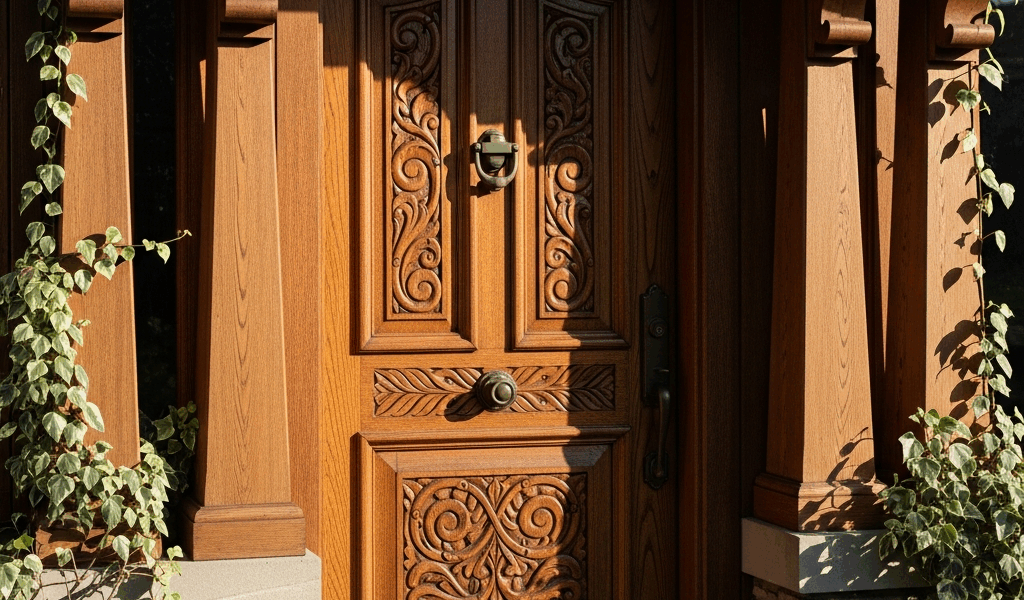
Authentic Craftsman porches run 8 to 12 feet deep — sometimes more. Wide enough to actually sit in, to put four chairs around a table, to spend a whole evening in without feeling cramped. The support columns taper from a thick base up to a narrower capital, usually set on stone or brick piers. That taper isn’t just visual habit. It makes the column look like it’s working, carrying load, doing something real — as opposed to the skinny decorative posts you see nailed onto builder-grade “Craftsman-style” houses today.
Columns are typically squared timber. A 6×6 is common; an 8×8 signals a finer house. Railings keep the geometry simple — repetitive squares or plain vertical balusters. No spindles. No curlicues. Wood, stone, concrete. Materials that are actually what they appear to be. That’s what makes Craftsman design endearing to us renovation obsessives — it asks nothing fake of itself.
Materials and Texture
Craftsman builders preferred regional, natural materials. Clinker brick — the kind with uneven color, fire-bloated edges, visible variation — was chosen specifically because it looked handmade. Uniform factory brick was exactly what they were arguing against. Wood siding typically shows a 4- to 6-inch reveal with a clean shadow line instead of ornate moldings.
Window frames are substantial. Two-inch casings were standard. The muntins dividing glass panes are real divisions — not plastic grilles stuck to the outside of a single sheet. I examined a restored 1912 home in Portland’s Ladd’s Addition neighborhood last spring where every window still had its original handblown glass. You could see the ripple. Slight waviness in the old panes. That’s not a flaw. That’s a timestamp.
Interior Details to Look For
This is where the philosophy gets personal. Interior Craftsman spaces weren’t designed to impress visitors — they were designed to actually live in.
Woodwork and Built-Ins
Quarter-sawn oak. Douglas fir. Sometimes chestnut on the East Coast before the blight took it. These weren’t painted over — the grain was the point. A real Craftsman interior makes you want to run your hand along the baseboards, the door casings, the stair rail.
Built-in bookshelves flank fireplaces. Glass-front cabinets with simple geometric muntins line dining room walls. These aren’t afterthoughts — they’re architectural features that define the room’s proportions. I spent a weekend evaluating homes in Seattle’s Ballard neighborhood in 2022, and I noticed pretty quickly that the quality of a house’s original built-ins directly tracked the quality of everything else. Elaborate hand-fitted cabinetry meant the owner didn’t cut corners anywhere.
Wainscoting rises typically 3 to 4 feet from the floor — plain framed panels, not Victorian raised-and-fielded ornament. Above it, plaster walls in warm period colors: ochre, sage, burnt sienna. A simple cap rail marks the transition. Clean. Purposeful. Nothing extra.
Ceiling Details
Box beams. Exposed joists. Coffered grids. These aren’t decoration — or at least, they weren’t originally. Craftsman architects didn’t believe in drywall ceilings that hid how the house was built. They exposed the skeleton.
A typical configuration runs exposed joists at 16 inches on center with decorative beams — sometimes structural, sometimes applied — forming a grid. Beam dimensions run 4×6 to 6×8 depending on span. The recessed coffering between beams creates shadow lines that make the ceiling feel three-dimensional. In finer homes, corbels supporting the beams are hand-carved with simple geometric or leaf motifs. Not fussy. Just present.
The Fireplace
The Craftsman fireplace isn’t a heating appliance. It’s the room’s center of gravity. The surround — clinker brick, river rock, or handmade art tiles — rises with genuine mass. Hearths sit 12 to 18 inches above floor level. The chimney breast anchors the entire wall.
Craftsman-era tiles from potteries like Grueby or Batchelder are the holy grail. Batchelder Tile Company, operating out of Los Angeles from 1909 onward, produced matte-glazed, hand-pressed tiles with visible texture and colors that have actual depth to them — not the flat uniformity of modern ceramic. Original signed Batchelder tiles run $200 to $400 each at auction today. I’m apparently drawn to expensive taste in antique ceramics, and tracking down a set of six original Batchelder hearth tiles works for me while the reproduction versions never quite satisfy. Don’t make my mistake — buy one real one instead of a dozen fakes.
Authentic Craftsman vs Builder-Grade Copies
Here’s where my 2015 renovation mistake becomes instructive. I walked into a Home Depot, bought a full set of hardware labeled “Craftsman-style” — hinges, drawer pulls, cabinet knobs, the works. Around $47 total. Installed everything. Stepped back. Felt immediately that something was wrong.
A real Craftsman drawer pull is iron or bronze — sometimes copper, occasionally hammered brass — with simple geometric forms and actual weight in the hand. Originals or quality reproductions run $8 to $25 per pull from suppliers like House of Antique Hardware or Rejuvenation. The pot-metal pulls I’d bought were visibly hollow when I compared them side by side with a single period piece from an estate sale. The difference wasn’t subtle.
Modern builder-grade “Craftsman-style” homes make specific, repeatable mistakes:
- Fake foam or MDF beams glued to drywall ceilings
- Plastic grilles snapped onto single-pane windows to simulate divided lights
- Wood-grained laminate on cabinetry — thermally fused, not wood
- Trim that’s the right shape but the wrong scale — too thin, too flat, too light
- Premium materials only where visitors look, cheap materials everywhere else
Authentic houses were overbuilt. Joists heavier than code required. Wood thicker than necessary. Finishes applied in hidden places — inside closets, under stairs, behind panels — with the same care as the entry hall. That’s the real tell.
When evaluating a house claiming to be Craftsman, run through this:
- Does the construction date fall between 1905 and 1930?
- Are the materials honest — wood showing grain, brick showing variation, stone left unpolished?
- Do the structural elements look like they’re actually doing structural work?
- Open a closet. Look under the stairs. Is the craftsmanship still there?
- Do the proportions feel inevitable, or do they feel random?
Famous Craftsman Architects and Their Best Work
Knowing the movement’s best work calibrates everything else. Once you’ve seen the ceiling at the Gamble House, you understand what every other Craftsman ceiling is reaching for.
Greene and Greene
Charles Sumner Greene and Henry Mather Greene, brothers based in Pasadena, built some of the finest houses ever constructed on American soil. Full stop. I spent two hours at the Gamble House — 4 Westmoreland Place, Pasadena, completed 1908 — and left feeling like I hadn’t seen half of it.
Teak, mahogany, and oak throughout. Joinery that’s not just visible but celebrated — ebony pegs, proud tenons, hand-fitted joints that look like jewelry. The proportions feel mathematically correct in a way you sense before you analyze. Their Japanese influence is unmistakable: the same honesty about materials, the same belief that emptiness can be as meaningful as mass. Their houses breathe in a way that most houses don’t.
Gustav Stickley and the Bungalow Movement
Stickley is better known for his furniture — the Harvey Ellis-influenced pieces from around 1903 to 1904 are particularly good — but his residential influence ran just as deep. He championed the bungalow as a serious architectural form, not a small house. A different idea entirely: efficient, honest, beautiful without pretension, accessible to working families.
Frustrated by the gap between his philosophy and what most Americans could afford, Stickley used The Craftsman magazine to publish house plans that carpenters could actually build from. Thousands of modest bungalows across the Midwest and East Coast trace directly back to those published designs. That was 1901 through 1916. The magazine folded when Stickley’s business collapsed, but the houses remained.
Regional Variations
The movement adapted wherever it landed. Pacific Northwest builders worked with heavy timber and exposed post-and-beam construction — the old-growth forests made that sensible. California bungalows pushed interior and exterior together with deep porches and sleeping porches. East Coast versions stayed more reserved, nodding toward Colonial proportions.
Frank Lloyd Wright sits in complicated relationship to all of this. The Prairie School maintained Craftsman’s honest expression of materials and structure — I’m apparently a Prairie School defender and the Robie House works for me while pure Craftsman never quite scratches the same itch. But Wright pushed toward a modernism that left the movement’s historical rootedness behind. Whether that’s an evolution or a departure depends on who you ask.
Why These Houses Matter Today
A 110-year-old Douglas fir beam looks better now than the day it was milled. That’s not an accident — it’s what happens when someone builds for the long term with materials that age honestly. The proportions in these houses still feel right. The spaces flow. The craftsmanship endures.
Craftsman style home features aren’t a decorative checklist. They’re a record of decisions made by people who believed that how you build something says something about who you are. When you understand that, you stop looking at the exposed rafter tails and start understanding what they’re saying. And then you can’t un-hear it.



Leave a Reply