Mid-Century Modern vs Contemporary — What’s Actually the Difference?
This debate has gotten complicated with all the mislabeled listings, vague Pinterest boards, and showroom sales reps throwing both terms around like they’re interchangeable. I’ve been there — stood in a furniture store for a solid ten minutes trying to explain to a guy that I wanted “that MCM vibe but something current” and he looked at me like I’d asked him to rewire the building. Today, I will share everything I’ve pieced together, because most explanations out there are genuinely useless.
The Core Difference in 30 Seconds
But what is mid-century modern, really? In essence, it’s a historical style locked to a specific window — roughly 1945 to 1969. But it’s much more than that. It has a fixed cast of designers, a fixed visual identity, a fixed cultural moment baked into every tapered leg and walnut veneer. It doesn’t evolve. It doesn’t need to.
Contemporary design is the opposite situation entirely. It means what’s happening right now. Literally right now. In 2005, contemporary meant glass, steel, and a lot of cold gray surfaces. Today it runs warm, minimal, and deeply textural. Ten years from now it’ll mean something else — that’s the whole point.
One is a noun. The other is a verb. That’s what makes the distinction so hard to hold onto when you’re scrolling through furniture sites at midnight.
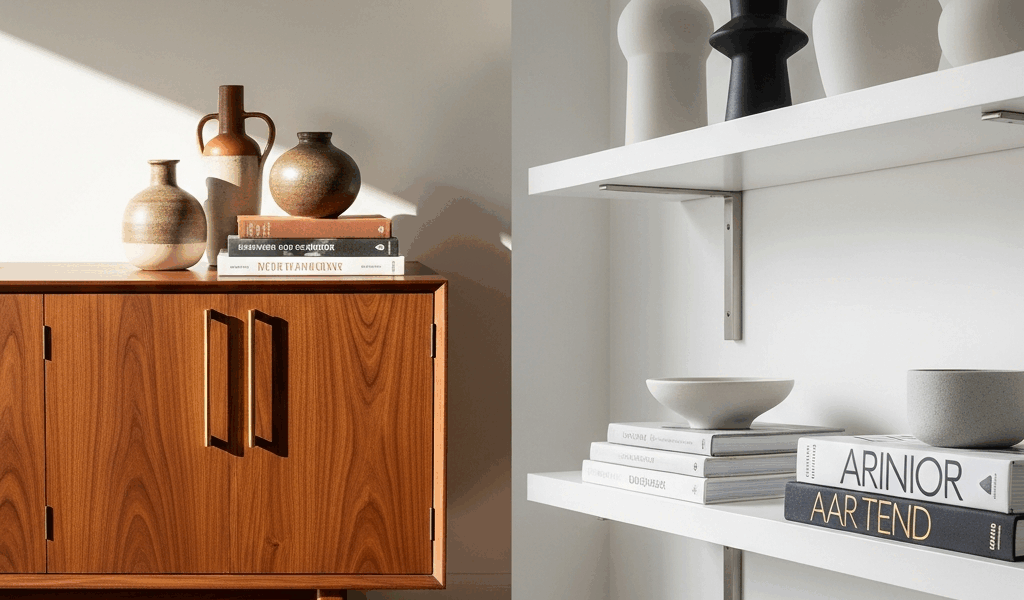
The real confusion kicks in because contemporary design in 2024 borrows heavily from MCM — warm wood tones, clean silhouettes, those organic rounded shapes that keep reappearing. The overlap is genuine. Both styles are playing similar notes right now, just from completely different sheet music.
Mid-Century Modern — The Specific Era
You can’t understand MCM without knowing what the world looked like in 1945. World War II ended. There was this enormous collective exhale — optimism, economic expansion, a housing boom that stamped millions of ranch houses and split-levels across the American suburbs almost overnight. Designers responded to that exact moment with furniture that felt new, forward-looking, almost aggressively hopeful about the future.
New manufacturing techniques made bent plywood and molded fiberglass suddenly viable. Charles and Ray Eames ran with this harder than anyone. Their molded plywood lounge chair — the 670, introduced in 1956, still sold by Herman Miller today at around $6,500 — is probably the single most recognizable piece of furniture from the entire era. Two pieces of molded walnut plywood, leather cushions, die-cast aluminum base. It looks like it fell out of a time capsule. Honestly, it kind of did.
Stumbling across an original Eames shell chair at an estate sale in 2019, I paid $140 for what turned out to be an early production fiberglass piece — not the later polypropylene versions they switched to. That one purchase taught me more about MCM than any design blog ever did. Always look at the underside of chairs. Don’t make my mistake of skipping that step.
The visual markers of genuine MCM design are specific:
- Warm hardwoods — teak, walnut, rosewood — used generously and left largely natural
- Organic, biomorphic curves pulled from nature (Eero Saarinen’s Tulip table, 1956, looks exactly like a flower stem — that was intentional)
- Hairpin legs, tapered legs, splayed legs — anything that lifts furniture off the floor and makes it read as light
- Color, but restrained — mustard, burnt orange, avocado, olive, used as accents rather than statements
- In architecture: large single-pane windows, flat or low-pitched rooflines, indoor-outdoor integration that felt radical at the time
The designers who defined this period are worth knowing by name: Charles and Ray Eames, Eero Saarinen, George Nelson, Hans Wegner, Arne Jacobsen, Florence Knoll, Robin Day. Their work wasn’t decorative for its own sake — it was trying to solve real problems. How do you make a chair that’s genuinely comfortable, cheap enough to manufacture at scale, and beautiful? The Eames DCW answered that in 1945 so well it’s still in production today.
MCM also had an architectural dimension that gets dropped from the conversation the second someone walks into a furniture showroom. The style is native to single-story ranch homes, California Case Study houses, post-and-beam construction, split-levels with open floor plans. Drop an Eames lounge chair into a Victorian with nine-foot ornate plaster ceilings and it’ll look like it’s waiting for a cab.
Contemporary — The Moving Target
Probably should have opened with this section, honestly, because understanding what contemporary is NOT clears up half the confusion immediately. It’s not “modern” — modern is an art historical term. It’s not minimalism, though current contemporary work leans that direction. It has no founding moment, no manifesto, no equivalent of the Eames.
Contemporary design is descriptive, not prescriptive. It means whatever working designers are building and selling right now, responding to current material costs, manufacturing capabilities, client preferences, and cultural mood. That’s it. So, without further ado, let’s get specific about what that actually looks like in 2024 — because it is a distinct look, even if it’s temporary.
Right now, contemporary interiors favor:
- Neutral palettes built around warm whites, greiges, and earthy tones — a hard departure from the cold grays that dominated from roughly 2015 to 2020
- Mixed materials — a dining table with a stone or concrete top on oak legs, a sofa in natural linen on a blackened steel frame
- Statement lighting, especially sculptural pendants in unlacquered brass or matte black — oversized, organic, impossible to ignore
- Textural layering using boucle fabric, raw linen, travertine, limewash plaster — texture doing the work that pattern used to do
- Soft curves mixed with clean lines — which is exactly where the MCM overlap creates confusion
The “warm minimalism” label gets applied to most of this, and it fits. Where 2010s contemporary felt cold — white, gray, glass, chrome — today’s version has warmth without tipping into maximalism. There’s wabi-sabi in there, some Scandinavian hygge, a quiet Arts and Crafts sensibility about honest materials. It’s a remix, essentially. That’s what makes contemporary endearing to us design obsessives — it never stops absorbing influences and recombining them into something that feels fresh.
This new idea of “contemporary as permanent remix” took off several years after postmodernism ran out of steam and eventually evolved into the fluid, reference-heavy aesthetic enthusiasts know and debate today.
Furniture and Decor — Side by Side
This is where it gets practical. Specific pieces next to each other.
The Sofa
A classic MCM sofa — something in the Knoll family, low profile, tightly upholstered, walnut legs, cushions in a solid warm tone — has no throw pillows piled on it. Clean, deliberate, a little austere. The Restoration Hardware Maxwell sofa in a Belgian linen, by contrast, is deeply cushioned, slightly oversized, low track arm, weathered oak leg at around $4,000 to $5,000 depending on configuration. That’s contemporary. Both are minimal. The MCM piece is angular and architectural. The contemporary piece is plush and tactile. Same general category, completely different intention.
The Dining Table
Eero Saarinen’s Tulip table — one pedestal in white-coated cast aluminum, Carrara marble top, circular form — is almost offensively perfect as an MCM specimen. Saarinen’s actual stated goal was eliminating what he called “the ugly, confusing, unrestful world” of table legs. The whole design solves one problem. A current contemporary dining table might be an 84-inch live-edge walnut rectangle on a blackened steel trestle base. Both care about materials. MCM solves an aesthetic problem. Contemporary celebrates material contrast instead.
Lighting
MCM lighting — the Nelson Bubble lamp, the Arco floor lamp at around $2,200 new — tends toward sculptural elegance with one resolved idea per fixture. Contemporary lighting right now is doing something more expressive: clustered pendant arrangements, beaten-brass sculptural pieces, Apparatus Studio-style work where the fixture itself functions as art. Both styles are confident about lighting. MCM restrains itself. Contemporary is more willing to be theatrical.
The Giveaway Details
- Tapered wood legs on upholstered pieces — almost always MCM or MCM-influenced
- Boucle fabric and travertine surfaces — contemporary right now
- Avocado or mustard as an accent color — MCM, full stop
- Unlacquered brass mixed with raw plaster — contemporary
- Molded fiberglass or plastic chair shells — MCM
- Oversized sculptural pendant as the room’s anchor — contemporary
Which Style Is Right for Your Home?
The architecture of your actual house matters here — and most design content skips this completely, which is a real problem.
MCM design has a native habitat. Ranch houses, split-levels, post-and-beam homes built between the late 1940s and mid-1960s — these were designed with MCM furniture in mind. Low ceilings, typically 8 feet. Horizontal proportions. Large single-pane windows. Open floor plans that move from kitchen to living area without interruption. Put authentic MCM pieces in these homes and everything snaps into place. The furniture looks like it belongs, not like it was acquired from a showroom and dropped in.
I’m apparently someone who learns exclusively through expensive mistakes, and furnishing a 1962 ranch with a massive RH Cloud sofa and heavily layered contemporary textiles worked for the mood board while never working in the actual room. The proportions were wrong in a way I couldn’t name for months — the sofa was too deep for the ceiling height, the whole thing felt slightly compressed. Contemporary furniture often assumes more volume than MCM homes actually provide.
Contemporary design is more architecturally flexible. New construction with open plans and 10-foot ceilings carries it naturally. A 1920s bungalow renovated with an open kitchen and updated windows can handle contemporary furniture without much visual conflict. It adapts. MCM doesn’t really adapt — it either fits the space or it doesn’t.
Both styles share one non-negotiable: neither wants to be crowded. Neither tolerates clutter. Open floor plans, architecture that can breathe, furniture chosen deliberately rather than accumulated. That shared sensibility is probably why the two get confused so often in the first place.
If you love walnut, the precision of a well-executed tapered leg, and the idea that a piece of furniture solved a specific design problem in 1952 and simply hasn’t needed improving since — MCM is your language. If you want to live in the current moment, update as culture updates, and work with living designers making things right now — contemporary gives you that freedom. Neither is wrong. They just answer different questions about what a home is actually supposed to feel like.



Leave a Reply