Vinyl Plank vs Laminate Flooring — Which One Wins
The vinyl plank vs laminate debate has gotten complicated with all the spec sheets, showroom upselling, and contradictory forum advice flying around. As someone who renovated the lower level of my house three years ago, I learned everything there is to know about this exact decision — mostly through a mistake that cost me a full floor replacement and several weekends I’ll never get back. Today, I will share it all with you.
The short version: these two floors are not interchangeable. The room you’re putting them in should be making the decision for you. So, without further ado, let’s dive in.
What Actually Separates These Two Floors
But what is vinyl plank, really? In essence, it’s a fully synthetic floor — PVC core, PVC layers all the way through. But it’s much more than that. It’s a floor that genuinely doesn’t care about water. Laminate is a different animal. Built around an HDF core — high-density fiberboard, which is compressed wood fiber — it’s treated to resist moisture. Not waterproof. Treated. There’s a meaningful gap between those two things.
Thickness changes how each floor feels underfoot. Vinyl plank runs 6mm to 12mm, and the softer PVC construction means thinner options can feel slightly hollow — like walking across a yoga mat stretched over plywood. Not great. Laminate in the same 8mm to 12mm range feels denser, firmer. A 12mm laminate plank often feels more substantial than a 12mm vinyl plank side by side. Different, anyway. Not always better.
Wear layers deserve attention too. Vinyl’s wear layer is measured in mils — 6 mil for basic residential, 12 mil for active households, 20 mil for commercial applications. Laminate uses an AC rating system running AC1 through AC5. Household with kids and a dog? You want at least 12 mil on vinyl or AC3 on laminate. Those aren’t arbitrary numbers someone invented to make the spec sheet look technical.
Where Vinyl Plank Beats Laminate Every Time
Probably should have opened with this section, honestly. Bathrooms. Laundry rooms. Basements. Mudrooms. Any room where water is a realistic part of daily life — vinyl plank is the only sensible answer. Full stop.
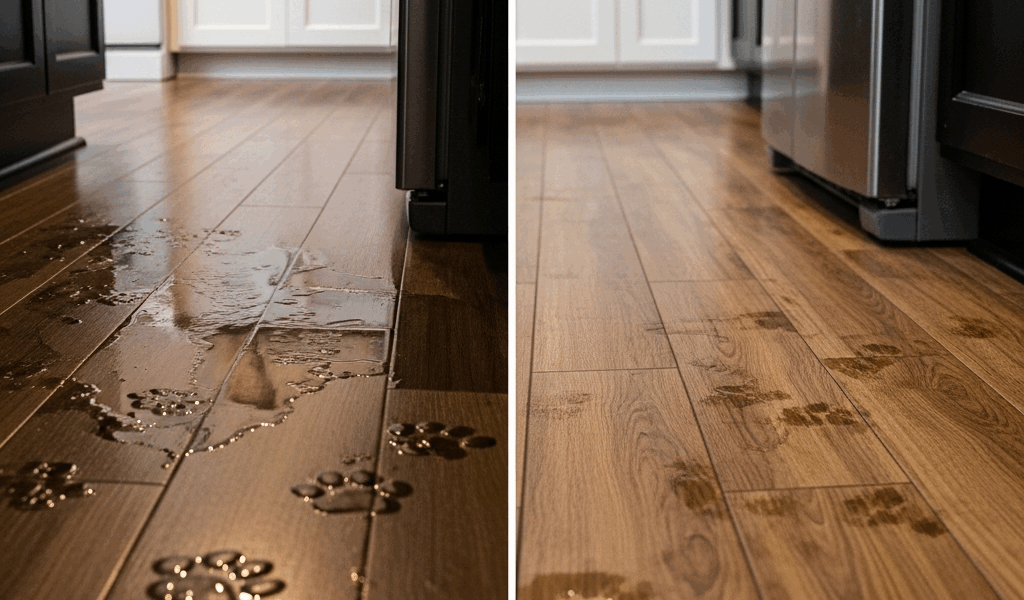
Here’s a scenario more common than people admit: a dog bowl gets kicked over and sits unnoticed for two hours. Or a slow drip develops under the bathroom sink — not a burst pipe, just a slow drip that takes three weeks to find. With vinyl plank, you clean it up and move on. With laminate, that HDF core has been absorbing moisture the entire time. Seams start lifting. Planks swell and buckle along the edges. In bad cases, mold develops underneath — the subfloor stayed damp under a floor that couldn’t tell you it was wet.
I made exactly this mistake. Frustrated by the price of vinyl plank at the time, I installed an AC4-rated laminate in my basement laundry room after scoring a deal — $1.49 per square foot at a Menards clearance event, 210 square feet total. The washing machine had a slow drain hose leak I didn’t catch for about three weeks. Within two months, three planks near the machine had buckled badly enough to become a tripping hazard. The lot number was discontinued. I pulled the whole floor. Don’t make my mistake.
That’s not a laminate quality problem, to be clear. That’s a laminate-in-the-wrong-room problem. Vinyl plank in that laundry room would have survived that leak without a single plank shifting out of place. That’s what makes vinyl plank endearing to us moisture-paranoid homeowners.
Vinyl also wins in:
- Basement bedrooms where humidity swings seasonally
- Mudrooms handling wet boots and tracked-in snow
- Rental properties where tenant habits are genuinely unpredictable
- Homes with dogs who drink enthusiastically and messily
Where Laminate Still Has the Edge
Dry rooms are laminate’s natural habitat. Bedrooms, home offices, living rooms, dining rooms — anywhere moisture isn’t a realistic threat — laminate performs beautifully. It often looks better than vinyl plank at the same price point, which matters when you’re covering 800 square feet.
The visual argument for laminate is legitimate. Better products use embossed-in-register technology — EIR — where the surface texture physically aligns with the printed wood grain underneath. The result feels and looks closer to actual hardwood than most vinyl plank at the same price. Pergo TimberCraft, Shaw Repel, Mohawk RevWood — these use EIR effectively. A quality laminate at $3 per square foot often has more convincing wood texture than vinyl plank at the same $3.
The underfoot feel is a real advantage in dry rooms too. That firmer HDF core doesn’t flex under furniture. Heavy bookshelves, bed frames, solid dining tables — laminate handles static load without complaint. Some vinyl plank in the 6mm to 8mm range can show slight indentation under very heavy pieces over time. I’m apparently sensitive to that kind of thing, and 12mm laminate works for me while thinner vinyl never quite did.
Laminate makes sense when you’re flooring dry rooms, working within a tight budget, and you’re willing to be careful about spills. The key word there is damp. Not wet. Damp socks walking across the floor — laminate handles it fine. Standing water — different story entirely.
Cost Comparison — Installation and Long-Term Value
While you won’t need a contractor’s license to understand flooring costs, you will need a handful of real numbers — not ranges so wide they tell you nothing. Here’s what the market actually looks like right now:
- Vinyl plank — materials: $2–$7 per square foot. LifeProof at Home Depot runs $3.49–$4.99. COREtec Plus 7mm lands around $4–$6.
- Vinyl plank — installed: $3–$8 per square foot with labor. Most standard residential installs land at $4–$6.
- Laminate — materials: $1–$5 per square foot. Entry-level 8mm from a big-box store runs $1.29–$1.99. Pergo or Shaw in 12mm sits at $3–$5.
- Laminate — installed: $3–$7 per square foot. Slightly cheaper than vinyl in most markets — the product cost is lower even when the labor process is nearly identical.
The numbers favor laminate upfront. A 400-square-foot living room in laminate might run $800–$1,200 in materials versus $1,200–$2,000 for comparable vinyl plank. That gap is real.
Laminate might be the best budget option, as dry-room flooring requires nothing more than basic scratch and wear resistance. That is because moisture protection — the main premium you’re paying for with vinyl — is simply irrelevant in a room that never sees water.
But a laminate floor that fails in a moisture-prone room doesn’t just cost replacement materials. Subfloor repair. Mold remediation. Lost weekends. One slow drain hose leak can turn a $1,200 floor into a $4,000 problem — ask me how I know. Vinyl plank in that same room, even at twice the material cost, is the cheaper floor across a 10-year window. The durability premium pays for itself when the application actually matches the product.
Which Floor Should You Actually Buy
First, you should walk through your home and label every room as either “moisture-possible” or “always dry” — at least if you want to make this decision without second-guessing yourself in six months. Then:
- Wet or moisture-prone rooms — bathrooms, laundry, basements, mudrooms: Vinyl plank. Not waterproof-rated laminate. Not water-resistant laminate. Vinyl plank.
- Dry rooms on a budget — bedrooms, offices, living rooms: Laminate wins. Put the savings toward a 12mm format and a decent underlayment — don’t cheap out on both.
- Whole-house installation across mixed room types: Vinyl plank by default. Running one consistent floor through wet and dry rooms is only possible with vinyl. The visual consistency is worth the added cost.
- Rental properties: Vinyl plank, always. You cannot control what a tenant does around water. You can control what floor you install before they move in.
- Homes with young kids or large dogs: Vinyl plank in any room that sees food, water bowls, or muddy paws. Laminate in dry upstairs bedrooms if budget is genuinely tight.
That’s the whole decision. Moisture-possible rooms get vinyl plank. Always-dry rooms can go either way — and laminate often wins on looks and price in those spaces. The rooms tell you what to buy. You just have to listen to them.



Leave a Reply