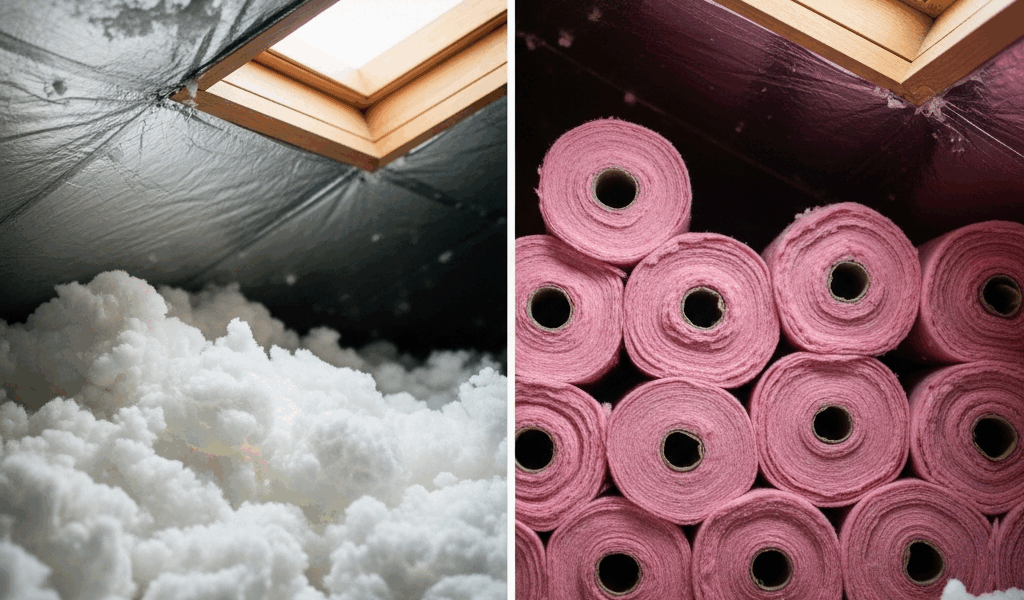
What Each Type of Insulation Actually Is
Blown-in vs batt insulation has gotten complicated with all the conflicting advice flying around. As someone who’s insulated three houses — two of my own and one rental property I bought in 2019 — I learned everything there is to know about this particular headache. Today, I will share it all with you. Including the mistakes. Especially the mistakes.
But what is blown-in insulation? In essence, it’s loose-fill material — either cellulose (recycled paper treated with borate) or fiberglass — pneumatically pushed into a space through a hose connected to a blower machine. But it’s much more than that. Cellulose is the go-to for both DIYers and professionals. It fills awkward gaps, works around obstructions, and reaches spaces you physically cannot. Looks like gray lint once it’s in. Bags of Greenfiber cellulose run $11–$13 at Home Depot — one bag covers roughly 40 square feet at R-13.
Batt insulation is different. Pre-cut rolls or panels of fiberglass or mineral wool — Owens Corning Pink, Rockwool Safe’n’Sound, that whole family — designed to press between studs or joists at standard 16-inch or 24-inch spacing. Cut it. Press it in. Done. No machine, no hopper, no two-person crew. It’s the pink stuff stapled between wall studs in every half-finished basement you’ve ever seen. That’s what makes batts endearing to us DIYers — the whole process fits inside a Saturday afternoon.
Where Each One Makes Sense — and Where It Does Not
Probably should have opened with this section, honestly. Location determines everything here. The product itself matters less than whether you’re using it in the right place.
Attics — Blown-In Wins
Adding insulation to an existing attic? Blown-in cellulose is almost always the right call. Attics have pipes, junction boxes, weird joist spacing, random gaps — batt simply cannot conform to all of it. Blown-in fills everything. You’re working horizontally across a flat plane, which makes the hose manageable even solo. A professional crew blowing cellulose from R-19 to R-49 across a 1,200-square-foot ranch runs $1,200–$1,800. Rent the blower from Home Depot yourself — usually free with 10+ bags purchased — and you’re looking at $400–$600 in materials total.
Open Stud Walls During New Construction — Batt Wins
When studs are exposed during framing, batt insulation is faster and cheaper than any blown-in alternative. No machine required. R-15 Owens Corning kraft-faced batt for a standard 2×4 wall runs about $1.10 per square foot installed DIY. Zero setup time. Cleanup is a few loose fibers. No blower rental to schedule around your framing crew. Mineral wool — specifically Rockwool Comfortbatt — is worth the premium if fire resistance and sound control matter to you. Expect $1.60–$1.80 per square foot at 2×6 depth. Not cheap, but it performs differently than fiberglass in ways the R-value label won’t tell you.
Finished Walls — Blown-In Wins, Clearly
Retrofit insulation in a finished wall is where blown-in cellulose earned its reputation. Drill a 2-inch hole every 16 inches horizontally across the wall, inject cellulose, patch the hole. That process is called drill-and-fill — works from the interior or exterior depending on your situation. It’s not glamorous. Your arms will ache. But it’s the only practical method for insulating an existing wall without tearing out the drywall entirely. Batt cannot do this job. Not a competition.
Crawlspaces and Basement Rim Joists — Batt Usually Wins
Rim joists — the band boards running along the perimeter of your floor system — are best handled with cut-and-cobble rigid foam or pre-cut mineral wool batts. Blown-in cellulose tends to drop out of rim joist cavities over time. Nothing holds it in place. I learned this the hard way in my second house — a 1974 ranch outside Columbus. Used cellulose in the rim joists, came back six months later, and half of it was sitting on the crawlspace floor in a pile. Don’t make my mistake.
Cost Comparison — What You Actually Pay Per Square Foot
Real numbers people use when making real decisions:
- Blown-in cellulose, professionally installed: $1.00–$1.80 per square foot depending on depth and region
- Blown-in cellulose, DIY: $0.35–$0.55 per square foot in materials — blower rental typically free with 10+ bags
- Fiberglass batt, professionally installed: $1.00–$1.50 per square foot for standard 2×4 walls at R-13
- Fiberglass batt, DIY: $0.50–$0.80 per square foot in materials
- Mineral wool batt (Rockwool), professionally installed: $1.60–$2.20 per square foot
- Mineral wool batt, DIY: $0.90–$1.30 per square foot in materials
The real cost gap lives in labor. Blown-in jobs need a two-person crew minimum — one feeding bags into the hopper, one running the hose. That’s $50–$75 per hour for a professional crew, with minimum job charges around $300–$400. Batt is genuinely one-person DIY territory. That distinction matters more than any per-bag price comparison ever will.
R-Value, Air Sealing, and Moisture — The Numbers That Matter
Fiberglass batt delivers R-3.2 to R-3.8 per inch. Blown-in cellulose delivers R-3.2 to R-3.8 per inch. Nearly identical on paper. Mineral wool batt sits at R-4.0 per inch — the best of the three for depth-constrained spaces like 2×4 walls where every fraction of an inch counts.
Where cellulose actually outperforms fiberglass batt isn’t raw R-value at all. It’s air infiltration. Blown-in cellulose settles into irregular voids and creates a denser fill that resists air movement through the insulation layer. Batt — especially when improperly cut or compressed around wires and electrical boxes — leaves small gaps. Those gaps don’t appear on any label. They appear on your energy bill, every single month, for years.
Moisture deserves a straight answer. Fiberglass batt doesn’t absorb water — but it traps moisture against framing when vapor barriers go in wrong, and that moisture just sits there doing damage. Cellulose is treated with borate, which resists mold, but it will hold moisture if it gets wet and stays wet. Neither product handles a bulk water problem well. Fix water intrusion first. Always. Full stop.
Which One Should You Choose
So, without further ado, let’s dive in — no hedging, no vague qualifiers:
- Existing attic, any age home: Blown-in cellulose. Rent the blower, buy the bags, finish it on a Saturday.
- New construction, open stud walls: Fiberglass or mineral wool batt. Faster, cheaper, no equipment needed.
- Finished walls, retrofit situation: Blown-in cellulose via drill-and-fill. Batt is not an option here.
- Rim joists and crawlspace perimeter: Pre-cut mineral wool batt or rigid foam cut-and-cobble. Skip the cellulose entirely.
- Sound-sensitive interior walls — home office, bedroom, anything near a TV room: Rockwool Safe’n’Sound batt. Purpose-built for acoustics, outperforms cellulose in this specific application.
- Budget-constrained attic with a straightforward layout: DIY blown-in cellulose. The $400 you spend returns more per dollar than almost any other home improvement on the list.
Frustrated by articles that refuse to just say the thing, I’ll be direct: insulating an existing attic or a finished wall means cellulose and a blower hose — at least if you want results without tearing everything apart. Framing fresh walls in a new build or addition? Grab the batts and skip the machine entirely. That’s the whole answer.



Leave a Reply