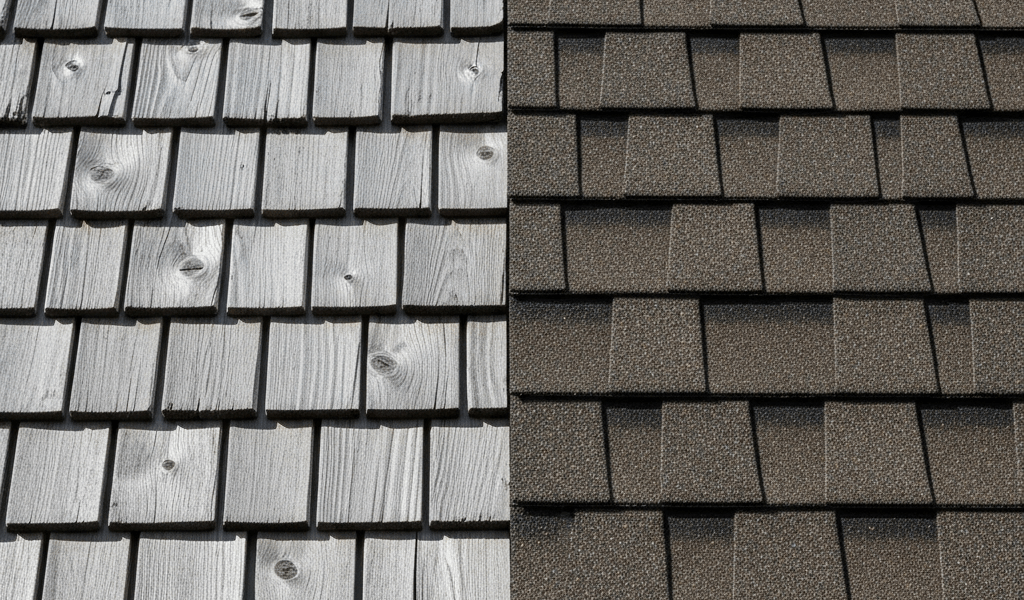
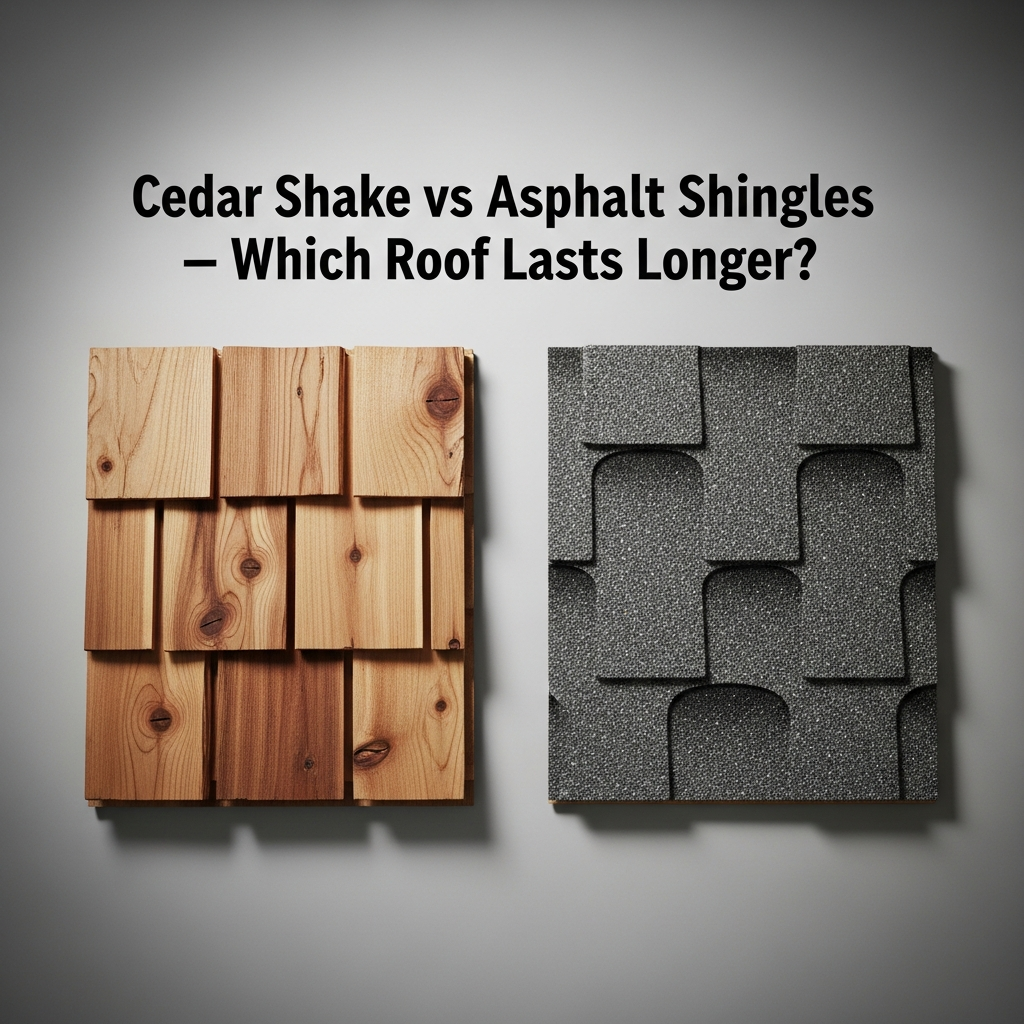
Cedar Shake vs Asphalt Shingles — Which Roof Lasts Longer?
Quick Verdict — Asphalt for Budget, Cedar for Character Homes
Cedar shake vs asphalt shingles has evolved with all the contractor bias and conflicting noise flying around. So here’s the short answer: for most houses, asphalt wins on cost and convenience. Full stop. But if you own a Craftsman bungalow, a Tudor revival, or anything built before 1960 that still has its original bones — cedar shake isn’t just a material choice. It’s a preservation decision, and the math changes considerably.
As someone who spent four months researching this before re-roofing a 1924 Craftsman in the Pacific Northwest, I worked through the fundamentals of this particular debate. Talked to three roofing contractors, two insurance agents, a historic preservation consultant. What I found was that nearly every contractor pushed whatever they happened to install most often. The asphalt guys thought cedar was a liability nightmare. The cedar specialists acted like asphalt was something you’d slap on a strip mall. Neither camp gave me a straight comparison. So here’s the one I wish I’d had.
Cedar shake costs two to three times more upfront than asphalt shingles — maintenance adds to that gap over time. But on certain homes — character homes, historic properties, high-end custom builds — cedar delivers an aesthetic that no asphalt product genuinely replicates. It holds resale value in neighborhoods where buyers expect it. On a new subdivision colonial or a 1990s ranch, nobody’s paying a premium for cedar. On a registered heritage property, some buyers will walk away without it.
That’s the real framework. Everything else is details.
Lifespan Comparison — The Real Numbers
Cedar shake, properly installed and maintained, lasts 30 to 50 years. Asphalt shingles range from 15 to 30 years depending on grade. Those ranges are wide — and the spread matters more than the midpoints.
Cedar Shake Lifespan
Thirty years is the floor for cedar, assuming you’re in a climate that’s reasonably kind to wood. Somewhere with dry summers and cold winters where the shake can actually dry out between wet seasons. Fifty years is achievable in those same climates with active maintenance. I’ve personally seen cedar roofs on heritage homes in Alberta and Montana pushing 45 years and still showing another decade of life. Silver-grey wood, tight grain. No curling, minimal cracking.
In humid coastal climates — Vancouver, Seattle, coastal Maine — cedar underperforms significantly. Sustained moisture breeds moss and mold. Without treatment every three to five years, a cedar roof in a wet climate can start showing serious degradation by year 20. That’s the tradeoff nobody at the cedar showroom mentions.
Asphalt Shingles — 3-Tab vs Architectural
Not all asphalt shingles are the same product. But what is an architectural shingle, exactly? In essence, it’s two asphalt layers bonded together into a single thicker unit. But it’s much more than that — it’s a fundamentally different lifespan conversation compared to standard 3-tab.
Learn from what tripped me up. I initially got quotes for 3-tab shingles because they’re cheaper, not realizing how dramatically different the lifespan actually is. 3-tab asphalt shingles are rated for 20 to 25 years. In reality — harsh climates with ice, heavy UV, strong winds — you’re looking at 15 to 18 years before they start lifting and cracking. Architectural shingles carry 30-year warranties from manufacturers like GAF Timberline HDZ or CertainTeed Landmark Pro. Some premium lines — GAF Camelot II, IKO Dynasty — carry 50-year limited warranties, though the fine print on those is worth reading carefully.
Surprised by the warranty on that Timberline HDZ, honestly. It changed my thinking about asphalt as a “cheap” option.
- 3-tab asphalt — 15 to 25 years, minimal wind resistance, flat profile
- Architectural asphalt — 25 to 35 years real-world lifespan, rated to 110–130 mph winds depending on product
- Premium architectural asphalt — 35 to 50 years, Class 4 impact resistance available, thicker profile
- Cedar shake — 30 to 50 years with maintenance, climate-dependent
Head-to-head, a premium architectural asphalt shingle in a moderate climate can genuinely match cedar shake on lifespan. The gap narrows to aesthetics, maintenance tolerance, and upfront budget. That’s what makes the comparison so endearing to us homeowners who just want a straight answer — there isn’t always one.
Cost Per Square — Installed
A “square” in roofing covers 100 square feet of roof surface. Standard unit. Everything gets priced per square.
Asphalt Shingles — Installed Cost
Expect $250 to $500 per square installed for asphalt shingles — region, roof complexity, and shingle grade all move that number. A basic 3-tab job on a simple gable roof in the Midwest might land around $260 to $280 per square. Architectural shingles on a moderately complex hip roof in a higher cost-of-living market run $380 to $480 per square installed. Premium products like the GAF Camelot II push toward $500 to $550 per square.
For a 2,000 square foot home with roughly 22 to 25 squares of roof surface, total installed cost runs $5,500 to $12,000 for asphalt. Wide range — but an accurate one.
Cedar Shake — Installed Cost
Cedar shake runs $600 to $900 per square installed. On that same 22 to 25 square roof, you’re looking at $13,200 to $22,500 installed. Western red cedar from BC suppliers tends to come in at the lower end. Hand-split and resawn shakes — the premium grade with a rougher, more rustic face — push toward $850 to $950 per square installed.
That’s roughly double to triple the cost of mid-grade asphalt. On a tight budget, that difference isn’t abstract — it’s a kitchen that doesn’t get updated, or a significant chunk of an emergency fund sitting on your roof instead.
Lifetime Cost Comparison
Quick note before the rest of this, because it reframes the whole conversation.
Over a 50-year period, an asphalt roof likely gets replaced at least once — twice if you went 3-tab. Call it two full replacements at $9,000 each, plus minor repairs of $300 to $500 every five years or so. Rough lifetime cost over 50 years: $20,000 to $25,000.
Cedar shake installed once, maintained every three to five years, repaired as needed: $18,000 to $22,500 upfront, plus $2,000 to $4,000 in maintenance over that same 50-year span. Total: $20,000 to $27,000.
They’re closer than people think. The real difference is cash flow — cedar demands more money now, asphalt spreads the cost into the future.
Maintenance Requirements — Where Cedar Gets Expensive
This section is where cedar shake loses most of the homeowners who start out enthusiastic about it. The maintenance requirements are real, consistent, and non-optional if you want that 40- to 50-year lifespan.
Cedar Shake Maintenance Schedule
Every three to five years, cedar shake needs to be cleaned and treated. Cleaning typically involves a low-pressure wash with a biocide solution — kills moss, algae, mold spores — followed by a wood preservative or penetrating oil treatment. Penofin Red Label Cedar Treatment is one commonly used product. Olympic Maximum Stain Sealer works on cedar as well. A professional application on a standard two-story home runs $800 to $1,500 depending on roof size and accessibility.
Skip one treatment cycle and you’ll probably be fine. Skip two or three and you’ll find cracked, cupped shakes, blackened wood, and early failure starting in the lowest courses and north-facing slopes first.
Frustrated by exactly this situation on a rental property I inherited, I ended up replacing a full north slope at year 22 — using a roofing crew, three dumpsters, and about six weeks of scheduling headaches — an entirely preventable $4,800 repair that better maintenance would have avoided. That lesson stuck with me going into my own reroofing project.
Moss and Mold in Humid Climates
Pacific Northwest homeowners face a specific challenge. Mild, wet winters create near-perfect moss growing conditions. Zinc or copper strips installed at the ridge line help — rainwater picks up trace metals as it runs down the slope, inhibiting moss growth. A 20-inch copper strip along the ridge runs roughly $150 to $300 installed, and it meaningfully extends treatment intervals.
Without it, moss can establish itself in 18 to 24 months on an untreated cedar roof in coastal climates. The roots are what damage the wood — they penetrate the grain and accelerate moisture retention.
Asphalt Maintenance Reality
Asphalt shingles might be the best low-maintenance option, as roofing generally requires some level of attention. That is because even durable materials need occasional checks — but asphalt keeps that bar remarkably low. Clear debris from valleys and gutters each fall. Check flashing around chimneys and skylights every few years. Replace individual blown-off shingles after major wind events. No treatments, no biocides, no specialized contractors.
For homeowners who don’t want to think about their roof — which is apparently most people — asphalt is genuinely the right answer.
Insurance and Fire Considerations
This is the part of the cedar shake conversation that brokers tend to bury in fine print. It deserves direct attention.
Fire Rating — Untreated Cedar
Untreated cedar shake carries a Class C fire rating. Class A is the highest resistance — concrete tile, metal, most asphalt shingles. Class C is the lowest accepted rating in most jurisdictions. In wildfire-prone areas — California, Colorado, parts of Oregon and Washington — Class C roofing materials are prohibited outright by local code. Check your municipality before specifying cedar shake anywhere with significant wildfire risk.
Class A pressure-impregnated cedar shake is available. Products treated with fire retardants — those meeting CERTI-GUARD or Fire Guard standards from the Cedar Bureau — achieve Class A ratings. The treatment adds roughly $80 to $120 per square to material costs and must be reapplied during maintenance cycles, since retardant concentration diminishes over time.
Insurance Premium Impact
Several major insurers — State Farm, Allstate, and others — charge higher premiums for homes with Class C roofing. Some have moved to outright refusing new policies on Class C roofs in high-risk zones. Two insurance agents I spoke with during my research both confirmed that cedar shake triggers an underwriting review at their companies that standard asphalt simply does not.
First, you should get an insurance quote before you commit to cedar — at least if you want to avoid a very unpleasant surprise three weeks before your installation date. Specifically ask your broker how the roof material affects your annual premium and whether your carrier will insure Class C cedar shake at standard rates. For treated Class A cedar, most carriers handle it comparably to asphalt.
- Untreated cedar shake — Class C fire rating, potential premium surcharge, restricted in high-risk zones
- Treated cedar shake (CERTI-GUARD) — Class A fire rating, standard insurance treatment in most markets
- Architectural asphalt shingles — Class A fire rating standard, no premium surcharge
- 3-tab asphalt — Class A fire rating, lower wind resistance classification
The treated cedar option threads the needle reasonably well — you keep the aesthetic, you get the fire rating, you avoid the insurance problem. You just pay for it in material costs and ongoing maintenance of the treatment itself.
At the end of my research, I went with architectural asphalt — CertainTeed Landmark Pro in Heather Blend, which has a dimensional texture that reads as more traditional than flat 3-tab on a Craftsman profile. Not cedar. But the right call for my timeline, my budget, my climate — and honestly, my patience for maintenance scheduling. In a drier climate with a more forgiving maintenance window ahead of me, I might have gone cedar. Both materials can be the right answer. The question is which variables matter most on your specific project.



Leave a Reply