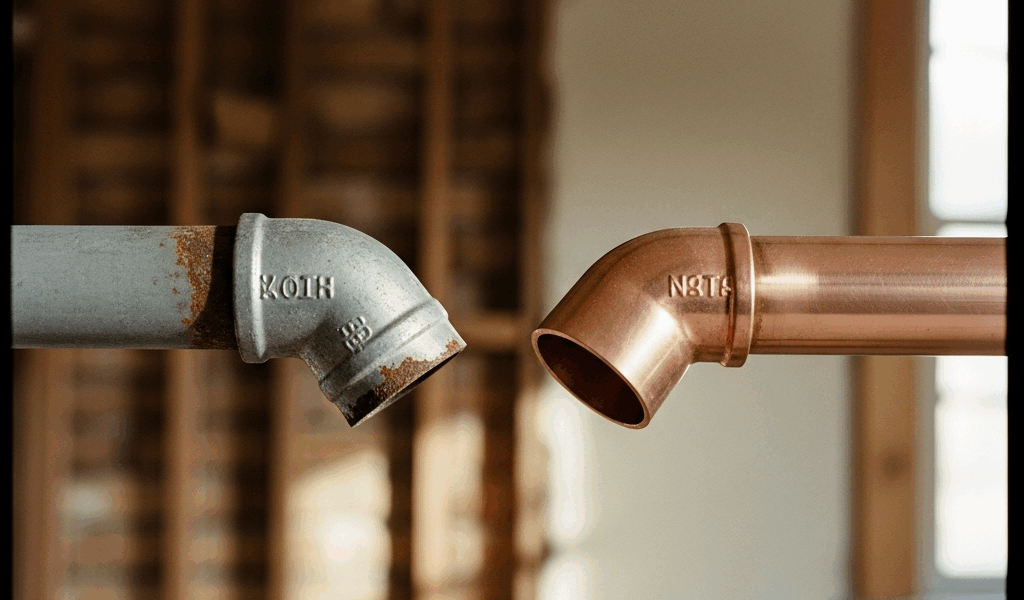
Why This Comparison Actually Matters
The galvanized pipe vs copper pipe debate has grown more complex with the renovation content and home inspection jargon flying around. As someone who bought a 1957 ranch house with original plumbing still intact, I picked up the practical knowledge of this subject the hard way. Today, I will share it all with you.
It gets real the moment a plumber crawls under your house and comes back with that specific look on his face. Maybe you’re gutting a 1950s bungalow. Maybe a home inspection just flagged “original galvanized plumbing” and you’re not sure if that’s a dealbreaker or a footnote. Either way, you’re standing at a decision point — one that affects water quality, your renovation budget, and honestly, your daily life. Galvanized pipe was the residential standard through the 1960s and into the early ’70s. Tens of millions of older homes still have it running through their walls right now. This comparison is for the people who actually live in those houses.
Galvanized Pipe — What You Are Actually Working With
But what is galvanized pipe? In essence, it’s steel pipe coated in a layer of zinc meant to prevent rust. But it’s much more than that — it’s also a ticking clock most homeowners don’t realize is already running.
The zinc coating wears away from the inside out over time. Then you’re left with bare steel sitting in water. Not a good combination.
The failure mode isn’t dramatic at first. Mineral deposits and rust slowly build up on the interior walls — think arterial plaque, but for your plumbing. The pipe doesn’t burst immediately. It just narrows. Quietly, over years and decades, your water pressure drops. You notice it first in the shower. Then you run the kitchen faucet at the same time and suddenly both are trickling.
Signs you’re already dealing with galvanized failure:
- Noticeably low water pressure throughout the house, not just one fixture
- Water that runs slightly brown or orange when you first turn on a tap in the morning
- Visible rust or white mineral crust at pipe joints
- Uneven pressure — strong at some fixtures, weak at others
- Any pipe that’s visibly pitted, flaking, or has been patched with a band clamp
Typical lifespan for galvanized pipe runs 40 to 70 years depending on water chemistry and installation quality. If your home was built in 1958 and still has the original plumbing, that pipe is somewhere between 65 and 67 years old. It is living on borrowed time. Full stop.
Copper Pipe — Why It Became the Standard
Copper took over residential plumbing for one straightforward reason — it doesn’t rust from the inside. The interior of a copper pipe in year 50 looks essentially the same as it did in year one. No buildup. No flow restriction. No rust particles finding their way into your morning coffee.
That’s what makes copper so endearing to us homeowners who obsess over long-term value. Practical lifespan runs 50 to 70-plus years, and plenty of copper systems installed in the ’70s and ’80s are still performing without issues. When I had my own house tested after a galvanized-to-copper repipe — this was back around 2019 — sediment readings dropped from concerning to basically nothing. Clear enough result.
Copper isn’t flawless, though. Honest breakdown of its vulnerabilities:
- Acidic water — homes with low-pH water, common with well water, can develop pinhole leaks in copper over time. Test your water before committing.
- Material cost — copper runs significantly more expensive than galvanized or PEX per linear foot. As of 2024, Type L copper runs roughly $2.50 to $4.00 per foot depending on diameter and supplier.
- Theft risk — vacant properties with copper plumbing get targeted. Not your concern if you’re living in the house, but worth knowing.
- Freeze vulnerability — copper can crack if pipes freeze and expand. Proper insulation handles this, but it’s a real consideration in colder climates.
None of those drawbacks change the overall verdict. Copper wins on longevity and water quality for the vast majority of residential situations.
Head-to-Head — Cost, Lifespan, and DIY Reality
Worth saying out loud. Here’s the direct comparison most people actually need.
| Category | Galvanized | Copper | Winner |
|---|---|---|---|
| Upfront material cost | Lower (~$1.00–$2.00/ft) | Higher (~$2.50–$4.00/ft) | Galvanized |
| Long-term cost | Replacement is inevitable | One-time investment | Copper |
| Lifespan | 40–70 years (degrading) | 50–70+ years (stable) | Copper |
| Water quality | Rust and sediment risk | Clean, no interior degradation | Copper |
| DIY difficulty | Hard — requires pipe threading tools, dies, and wrenches most homeowners don’t own | Moderate — sweat soldering with a Bernzomatic TS8000 and some practice is genuinely doable | Copper (slightly) |
| Professional labor | Harder to source — fewer plumbers work galvanized regularly | Standard skill, widely available | Copper |
On the DIY point — I’m apparently someone who underestimates threading galvanized pipe, and that learning curve works against me while patience never quite saves the situation. Threading galvanized requires a pipe threader rental from Home Depot or Sunbelt Rentals, around $40–$60 per day, plus dies, pipe wrenches, and cutting oil. I tried patching a section once. Stripped a thread on my second joint and called a plumber anyway. Steer clear of where I went wrong.
Copper sweat-soldering has a curve too — but the tools are cheaper, the technique is more forgiving, and there are genuinely good tutorials that get a careful beginner through straightforward repairs. Push-fit fittings like SharkBite 22632 connectors eliminate soldering entirely for smaller repairs. Push-to-connect and done.
Should You Replace Galvanized Pipe Right Now
So, without further ado, let’s dive in — here’s the practical decision framework, without the fog.
Replace now if: Your home is over 50 years old and still running on original galvanized. Don’t wait for a failure. Plan the repipe, budget for it, and do it on your schedule rather than in response to a burst pipe at 11pm on a Sunday.
Replace urgently if: Water pressure has dropped noticeably, water runs discolored when first turned on, or you’ve already had one leak. These are not warning signs — they are the failure itself, just in slow motion.
Monitor and budget if: Galvanized pipe in your home was partially replaced at some point, or is newer than 40 years old and showing no symptoms. Get it on your five-year plan. Test your water annually.
Frustrated by how often homeowners treat galvanized pipe as someone else’s future problem, I started asking plumbers which job they dread more — a full repipe planned in advance, or an emergency repipe after a flood. The answer was unanimous every single time. Do it planned. Every time.
For replacement material, copper might be the best option, as residential plumbing requires long-term reliability and broad contractor familiarity. That is because copper is proven, understood by every licensed plumber in every market, and it adds real appraised value to a home. While you won’t need a full construction crew, you will need a handful of good quotes and a realistic budget going in. First, you should also look seriously at PEX pipe — at least if you’re doing the work yourself or operating on a tighter budget. It’s flexible, freeze-resistant, cheaper per foot than copper at around $0.50–$1.00 per foot for PEX-A, and can be run with fewer fittings throughout the house.
What copper and PEX share, and what galvanized simply can’t offer anymore: a future. Old galvanized pipe had a good run. It does not have another one left in it.



Leave a Reply