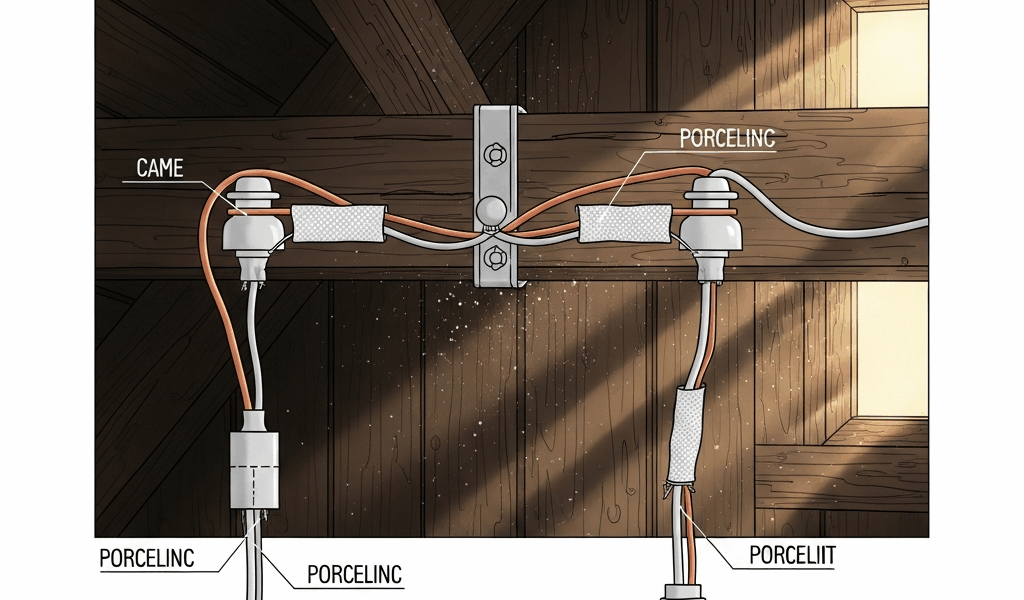
What Knob and Tube Wiring Actually Is
Knob and tube wiring has gotten less clear-cut with all the misinformation flying around. As someone who inherited a 1927 Tudor and spent the better part of last year untangling what that actually meant for my insurance, my safety, and my wallet, I figured out how to handle this subject. Today, I will share it all with you.
But what is knob and tube wiring? In essence, it’s ceramic knobs screwed into wooden framing, with copper wires threaded through porcelain tubes wherever they pass through walls. But it’s much more than that. There’s no ground wire — just two conductors, hot and neutral, wrapped in cloth insulation that, by now, has often crumbled to something resembling old newspaper. The system was genuinely cutting-edge in 1890. By 1940, electricians were already moving past it. By 1950, it was obsolete.
It ran through walls, attics, and crawl spaces in homes built between roughly 1880 and 1940. Rural areas sometimes kept installing it into the early 1950s. The logic made sense at the time — copper was affordable, houses pulled maybe a fraction of the electricity a modern refrigerator uses, and the whole point was just getting a light bulb to turn on.
If you’re in an older neighborhood — New England, the Mid-Atlantic, the Midwest — there’s a real chance it’s hiding in your walls. Victorian homes, Craftsman bungalows, Arts and Crafts cottages, old farmhouses. All candidates. That’s what makes knob and tube so enduring as a homeowner headache: it’s everywhere older people live and love their houses.
Signs Your Knob and Tube Has Become Dangerous
Here’s where most articles go wrong. They treat every strand of K&T like a lit fuse. I’ve personally seen original knob and tube that’s been sitting completely undisturbed for ninety years and still functions. I’ve also seen retrofitted versions that genuinely scared me. The difference matters enormously for what you decide to do next.
Original, Unmodified K&T
If the knobs and tubes are original, intact, the wires haven’t been spliced inside the walls, and nothing was added after 1950 — you’re looking at a legacy system. Annoying. Hard to insure. But not immediately dangerous the way a loose wire dangling near a wet basement floor is. There’s a distinction, and it matters.
Modified K&T — This Is Where You Should Worry
The real danger emerges when someone — a prior owner, a well-meaning handyperson, an electrician from 1987 who should have known better — got in there and modified things. Here’s what makes modified K&T genuinely risky:
- Insulation in contact with building materials. Cloth insulation touching wood framing, drywall, or insulation batts degrades faster and creates fire risk. Modern blown-in insulation wasn’t designed to cozy up against 90-year-old copper wiring.
- Splices hidden in walls. Someone wanting to extend a circuit will sometimes splice wires directly inside a wall cavity — no junction box, no access point, no way to ever check it again. Dangerous. Also illegal.
- Doubled-up circuits. I found this in my own attic. Two separate circuits running through a single ceramic tube. That tube was sized for one wire’s heat output. Two wires generate twice the heat. Insulation breaks down. Fire risk climbs.
- Heat damage or scorching. Look for blackening around the knobs, discolored tubes, or cloth insulation so brittle it crumbles when your fingernail touches it. Those are active failure zones, not just aging.
- Aluminum patches or tape repairs. Someone wrapped electrical tape around failing insulation instead of replacing the wire. This approach doesn’t work and typically makes the situation worse within a few years.
- Amateur modifications for newer appliances. A 1920s circuit cannot safely carry a 1990s electric range or a modern HVAC compressor. K&T running into a kitchen with a newer breaker panel bolted awkwardly onto it? That’s a patch job. Not a solution.
Frustrated by a nagging smell near my attic hatch, I went up there armed with a flashlight and garden shears, pulling back sections of 1970s blown insulation to see what was underneath. What I found looked like a bird’s nest made entirely of old electrical tape and mismatched wire nuts. That’s the afternoon I learned the real difference between “vintage” and “dangerous.” Learn from what tripped me up — go look before something forces you to.
Why Insurance Companies Hate It and What to Do
Let’s skip straight to the real pressure point. Most homeowners don’t think about knob and tube until an insurance company suddenly makes it their entire problem.
Insurers aren’t rejecting policies out of some superstition about old houses. They’re working from claims data. Homes with active K&T file more electrical fire claims than homes with modern wiring. Whether the wiring itself is failing or whether K&T homes just tend to be older and less maintained overall — that debate is genuinely interesting and also completely irrelevant to your underwriter. The risk model says no, and the risk model wins.
Some companies will cover K&T if it’s confined to non-critical areas. Some won’t touch it regardless. Most charge a premium somewhere in the $300–$500 per year range. In states with tight insurance markets — Florida, California, I’m looking directly at you — coverage may not be available at any price.
So, without further ado, let’s dive in to what actually helps:
- Get a licensed electrician to inspect the system and write you a letter documenting findings. “Original K&T, unmodified, in good condition” lands very differently with insurers than “mixed K&T and modern wiring with amateur splices throughout.”
- Ask your insurer specifically what would get you approved or reduce your surcharge. Some accept partial rewiring. Some want a full replacement and won’t negotiate.
- If full rewiring isn’t immediately feasible, ask about rewiring the highest-risk zones first: kitchen, bathrooms, laundry room, attic. Bring the electrician’s inspection plus a written scope of work when you have that conversation.
- Don’t hide it. Misrepresenting K&T to get coverage will void your policy if there’s a fire. Not worth it — not even close.
I’m apparently the kind of person who calls three insurers in one afternoon, and that approach worked for me while doing nothing never would have. Two demanded full replacement before they’d write a policy. The third agreed to cover me with a $400/year surcharge while I executed a phased rewire over 18 months. That third company saved me eight months of genuine panic.
Full Replacement vs. Partial Rewiring — What Makes Sense
The piece that matters most here. Here’s the financial reality first.
A complete rewire of a 2,000-square-foot older home runs $8,000 to $20,000. The spread depends on how much wall needs opening, whether you’re dealing with finished plaster or drywall, and how complex the original layout is. Big Victorian with balloon framing? Budget toward $20,000. Small Craftsman cottage? You might land near $8,000 if the electrician doesn’t hit surprises.
Partial rewiring costs less, obviously. A kitchen rewire typically runs $1,500–$4,000. Bathrooms, $1,000–$2,500 each. Attic runs, $800–$2,000. Wire the kitchen, primary bathroom, laundry room, and accessible attic, and you’re usually at $5,000–$10,000 total — covering the zones that statistically account for most residential electrical fires.
Partial rewiring might be the best option, as knob and tube remediation requires careful prioritization. That is because not every section of K&T carries equal risk, and spending strategically on the high-load, high-moisture areas first gives you the most safety per dollar spent. When does partial actually make sense?
- Your K&T is original and unmodified in low-traffic areas — living rooms, bedrooms — with no signs of heat damage.
- Your insurer will accept partial coverage with documentation.
- You’re not planning to stay beyond 5–10 years and can tolerate the annual premium.
- Budget constraints are real, and a phased approach is honest planning rather than avoidance.
Full replacement is the only answer when:
- You found active modifications, hidden splices, or visible heat damage anywhere in the system.
- A major renovation is already planned — kitchen, bathrooms, second floor work — because the walls are opening anyway.
- Insurers flatly won’t budge without complete replacement.
- You’re staying 15+ years and want to stop thinking about this permanently.
The honest version: if you can afford full replacement, do it. If you can’t, partial rewiring plus a real conversation with your insurer beats doing nothing by a wide margin.
How to Find an Electrician Who Knows Old Homes
While you won’t need to find some rare specialist who only works on pre-war houses, you will need a handful of specific qualities that separate electricians who actually understand old systems from those who just want to pull everything out and start over.
First, you should ask directly about their K&T experience — at least if you want an assessment you can actually trust. Here’s the full list of what to ask:
- Have you specifically diagnosed and worked with knob and tube systems? Ask for examples of homes they’ve evaluated, not just replaced.
- Can you provide an itemized inspection report before committing to a full rewire quote? You need to know what’s original, what’s modified, and what’s actively dangerous — in writing.
- Do you understand the original circuit layout logic of homes from this era? This affects efficiency. Some electricians rewire without considering how the original circuits were planned, which creates unnecessary cost.
- Are there local historic preservation rules that apply here? Some districts restrict visible conduit or require aesthetics that match the home’s period. Worth knowing before demo begins.
Get at least two full inspections and quotes. Prices vary wildly — a $5,000 quote and a $15,000 quote for the same house can both be legitimate depending on scope, but you need to understand exactly what each one includes before signing anything.
Knob and tube isn’t a home-killer. It’s a solvable problem with a clear enough decision path: know what you have, get it inspected by someone who understands it, talk honestly with your insurer, plan the work in whatever phases your budget allows, and execute. You’ll sleep considerably better than you’re sleeping right now.




Leave a Reply