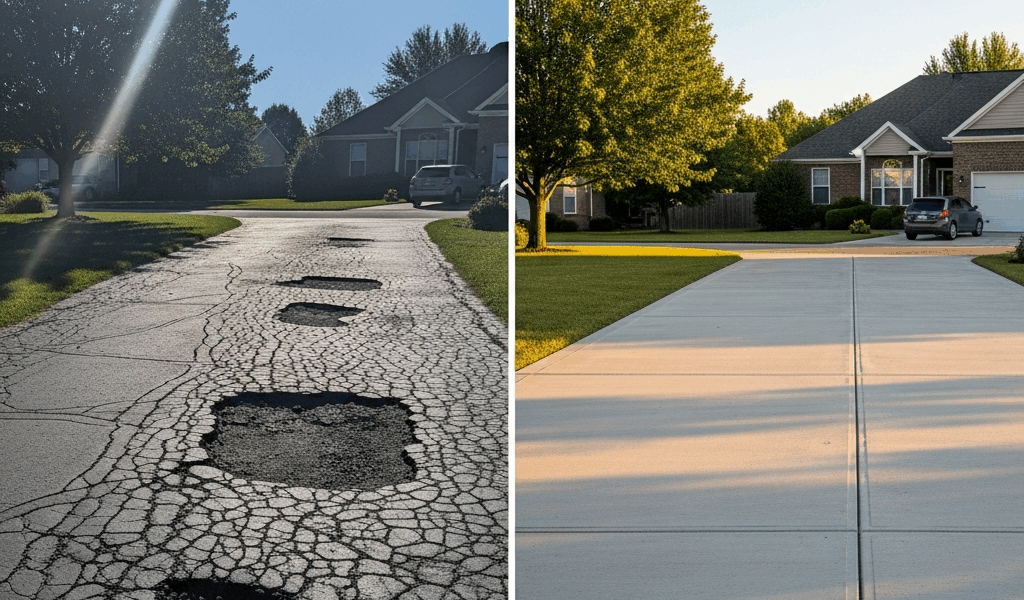
Asphalt Driveway vs Concrete Driveway — Which Wins
The asphalt driveway vs concrete driveway debate has gotten messy with all the half-baked advice flying around. As someone who spent three years managing residential construction projects across the Midwest, I picked up the practical knowledge of this particular headache. Today, I will share it all with you. And look — I’ve watched enough homeowners make the wrong call to know that most of what’s out there skips the stuff that actually matters. This isn’t about which one photographs better on a real estate listing. It’s about your climate, your real budget over time, and how much maintenance you’re genuinely willing to do.
The Core Differences You Actually Need to Know
But what is asphalt, really? In essence, it’s crushed stone and gravel bound together with bitumen — a tar-like byproduct of crude oil refining. But it’s much more than that. It gets laid hot, compacted in layers, and cures within a day or two. Concrete, meanwhile, is a mixture of cement, water, sand, and aggregate. Poured, finished, then left to cure roughly 7 days before you drive on it. Full structural strength takes 28 days.
That compositional gap isn’t trivia. Asphalt is semi-flexible. Concrete is rigid. Every other comparison point — flexibility, heat response, repair options, cost structure — traces straight back to that. Keep it in mind as you read the rest of this.
Upfront Cost vs Long-Term Cost
Worth mentioning before anything else.
Asphalt runs roughly $3 to $5 per square foot installed. Concrete runs $6 to $12 per square foot — depending on your region, finish type, and whether any decorative work is involved. For a standard 600 square foot driveway, that’s approximately $1,800 to $3,000 for asphalt versus $3,600 to $7,200 for concrete.
Asphalt looks like the obvious winner. It isn’t — at least not once you run the 20-year math.
Asphalt needs a seal coat every 3 to 5 years. Budget $250 to $500 each time for a driveway this size, depending on whether you DIY or hire out. By year 15 to 20, resurfacing enters the picture — that’s $1,200 to $2,500 on its own. Add it up and your 20-year cost on that 600 square foot driveway realistically lands between $4,500 and $7,000.
Concrete with proper installation and basic upkeep — joint sealing every few years, maybe a crack repair here and there — might cost $500 to $1,000 in maintenance over 20 years. Total outlay: $4,100 to $8,200. The gap closes significantly. And concrete routinely lasts 30 to 50 years. Asphalt’s realistic lifespan is 20 to 30 years with solid maintenance. Spare yourself the wrong turn I took of only quoting clients install costs. The full picture looks very different.
How Climate Affects Which One Holds Up
This is the section most comparison articles skip entirely. Wild, because it might be the single most important variable of all. So, without further ado, let’s dive in.
Asphalt flexes. That’s its superpower in cold climates. Ground in Minnesota or Vermont freezes and thaws repeatedly every winter — it moves. Rigid concrete cracks under that stress. Asphalt shifts slightly with the movement and tends to hold together better. If you’re in USDA Hardiness Zone 5 or colder — think Chicago, Denver, Boston — asphalt has a genuine structural advantage.
Flip the geography and the story changes. Asphalt is petroleum-based, and heat softens it. In Phoenix, Houston, or anywhere regularly hitting 95°F and above, asphalt gets tacky, ruts under vehicle tires, and loses surface integrity faster than any manufacturer timeline suggests. Concrete doesn’t care about heat the same way. It just stays hard. That’s what makes concrete endearing to us hot-climate homeowners.
- Cold climates with hard winters — asphalt holds up better through freeze-thaw cycles
- Hot climates with mild winters — concrete handles thermal stress without softening
- Moderate climates — either works; budget and aesthetics take over from there
Frustrated by a climate that’s both brutal in winter and scorching in summer — like parts of Kansas or Missouri — many homeowners eventually just call a local contractor. Smart move. They’ve seen what survives 10 years in your specific zip code. That’s data no national article can hand you.
Maintenance, Repairs, and What Goes Wrong
While you won’t need a contractor on speed dial, you will need a handful of basic supplies in the asphalt camp. A tube of Dalton Enterprises Pli-Stix crack filler from Home Depot runs about $14 and handles surface cracks cleanly. Potholes can be cold-patched with Sakrete U.S. Cold Patch — around $20 a bag. Expect a repair task every 3 to 5 years as normal ownership. That’s just the deal.
Sealing is non-negotiable. Skip it and UV degradation accelerates, the surface gets brittle, and small cracks turn into big ones fast. A 5-gallon bucket of Latex-ite Trowel & Pour covers roughly 250 square feet and costs around $25 at any big box store. For 600 square feet, you’re spending $60 to $80 in materials to DIY a seal coat. Honestly, not terrible.
Concrete is lower frequency but higher stakes when something goes wrong. Epoxy fillers and polyurethane sealants exist — but matching the color and texture of surrounding slab is genuinely difficult. Repairs are visible. That bothers some people more than others. I’m apparently in the “it would drive me insane” category, and asphalt works for me while concrete never quite does.
First, you should think carefully about oil stains — at least if you own an older vehicle with any kind of slow leak. An asphalt driveway hides drips completely. A concrete driveway does not. One leaky car and you’ve got a permanent dark stain that no amount of degreaser fully removes. Sounds minor until it’s your driveway.
Tormented by a brutal Michigan winter, one concrete driveway owner discovered this the hard way — road salt tracked in by tires began pitting the surface within four years of installation, using nothing more exotic than the same winter roads everyone else drove. Asphalt largely shrugs that off. This new awareness of salt damage took hold among several homeowners in that neighborhood and eventually evolved into the “always ask about salt resistance” question that informed buyers know to ask today.
Which One Should You Actually Choose
Skipping the vague “it depends” answer. Here’s a direct read based on real conditions:
- Cold climate, tighter budget — Asphalt wins. Lower install cost, better freeze-thaw performance, easy repairs. Commit to sealing it on schedule and it’ll serve you well.
- Hot or moderate climate, low-maintenance priority — Concrete might be the best option, as this climate requires long-term surface stability. That is because heat doesn’t soften it, and you simply won’t be out there sealing it every few years.
- Hot climate, older car with an oil leak — Asphalt wins on stain concealment alone. Real quality-of-life issue. Don’t underestimate it.
- Upscale neighborhood, resale-focused — Concrete edges ahead on curb appeal, particularly with a brushed or exposed aggregate finish. Neither material is a guaranteed ROI boost, but concrete skews better in markets where buyers expect premium finishes.
Resale value deserves a quick note. Neither asphalt nor concrete dramatically moves your appraisal on its own. A clean, well-maintained driveway in either material beats a cracked, neglected one in the “better” material — every single time. Condition matters more than composition when a buyer is standing in your driveway sizing things up.
One action step you can take today: get two quotes — one for each material — from licensed local contractors. Ask each one what they’ve installed in your neighborhood over the last five years and which they’d put in their own home. That question cuts through sales talk fast. You’ll have a real answer by end of week.




Leave a Reply