Crawl Space vs Basement — Which One Is Worth It
The crawl space vs basement debate has become tricky with all the half-answers and contractor upsells flying around. As someone who bought a 1960s ranch house with a crawl space that turned into a humidity nightmare — and later talked a family member off a ledge when a basement upgrade quote nearly tanked their entire new build — I dug into the practical details of this subject the hard way. Today, I will share it all with you.
What You Actually Get With Each Foundation Type
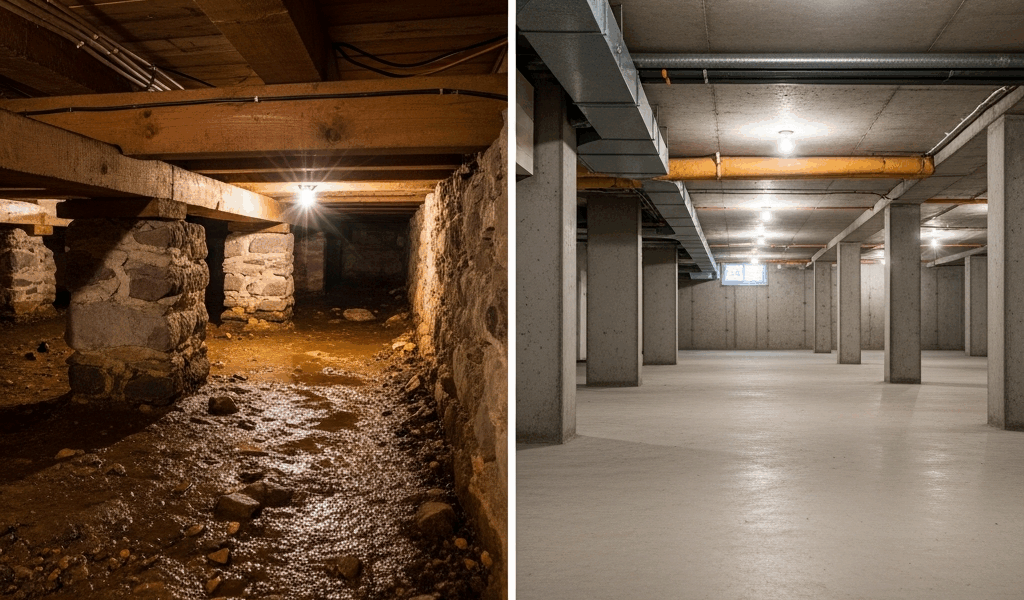
But what is a crawl space, exactly? In essence, it’s a shallow gap between the ground and your first floor — usually 18 inches to 4 feet of clearance. But it’s much more than that. It’s where your HVAC ductwork, plumbing, electrical runs, and the underside of your subfloor all live. No storage. No usable square footage. No man cave. You send a technician into a crawl space, not yourself on a Sunday afternoon with a folding chair.
A basement is a different animal entirely. Standard ceiling height runs 8 to 9 feet. Finish it. Store things in it. Put a bedroom or home gym down there. Leave it unfinished and still get actual square footage out of it. The furnace, water heater, and sump pump are still down there — but now they share the room with everything else you want.
That’s what makes basements endearing to us buyers who grew up watching home renovation shows. The daily reality of owning one versus a crawl space isn’t subtle. One gives you a floor of hidden potential. The other gives you easier access to pipes when something leaks at 2 a.m. Those are genuinely different lives.
Cost to Build and Cost to Maintain Over Time
Here’s where people get surprised. The upfront gap is real. The lifetime cost gap is much smaller than it looks on paper.
Initial Construction Costs
Crawl space foundations typically run $7 to $15 per square foot, depending on region, soil conditions, and depth. On a 1,500 square foot footprint, that’s roughly $10,500 to $22,500. A full basement on the same footprint? $30 to $50 per square foot — so $45,000 to $75,000 before a single finishing dollar gets spent. Nobody’s pretending that gap doesn’t exist.
The Hidden Long-Term Costs of Crawl Spaces
This is the piece to know up front. The crawl space looks cheaper right up until you start counting what it actually demands over time.
- Vapor barrier installation — $1,200 to $4,000 depending on size and whether you’re laying basic 6-mil poly sheeting or going with a full encapsulation system
- Full crawl space encapsulation (the real fix) — $5,000 to $15,000 for a professionally sealed, insulated system
- A standalone dehumidifier — the Santa Fe Advance2 runs about $900 to $1,200 and needs to run continuously in humid climates
- Sump pump installation if water intrusion shows up — $1,000 to $3,000
- Ongoing pest inspections and treatments, since crawl spaces are basically an engraved invitation for rodents and termites
Stack those up over a decade and that gap between crawl space and basement starts shrinking fast. Basements carry waterproofing costs too — interior drainage systems, sump pumps, exterior membranes — but you’re getting livable square footage back in exchange. That’s a very different equation.
Moisture, Mold, and Structural Risk Compared
This is the section that keeps homeowners up at night. It should, a little.
Why Crawl Spaces Attract Moisture
Ground moisture evaporates upward. Without a proper barrier in place, that moisture migrates into the crawl space, settles on wood joists and subfloor material, and starts growing mold within weeks under the right conditions. I found this out firsthand in that 1960s ranch. The home inspector flagged “some moisture present” and I didn’t push on it. Skip past the mistake I made.
Six months in, I had visible mold on three floor joists and a musty smell that had crept into the living room above. The fix was full encapsulation — closed-cell foam insulation on the walls, a 20-mil vapor barrier on the floor, and a Santa Fe Classic dehumidifier running year-round. Total cost: just under $11,000. Lesson learned hard.
Climate matters enormously here. In the Southeast, the Gulf Coast, or the Pacific Northwest, an unencapsulated crawl space isn’t a question of if it becomes a problem — it’s when. In drier climates like the Mountain West or parts of the Southwest, a basic vapor barrier is often genuinely sufficient.
Basement Flooding and Waterproofing Reality
Basements carry their own water risk — especially in areas with high water tables, clay-heavy soil, or heavy spring snowmelt. A flooded basement can destroy flooring, drywall, stored belongings, and HVAC equipment in a single afternoon. Preventive investment usually means an interior French drain system, a sump pump with battery backup (the Zoeller M53 is the reliable workhorse here), and exterior grading that moves water away from the foundation wall.
Waterproofing a basement properly runs $4,000 to $12,000 depending on square footage and severity. When it’s done right, you have a genuinely protected, usable space. The risk profile is different from a crawl space — not necessarily worse. Just different in character.
Soil type, regional water table depth, and historical rainfall patterns for your specific address matter more than any general rule. Pull the FEMA flood zone map for your property. Check the USDA Web Soil Survey tool. Both are free and take about fifteen minutes.
Resale Value and What Buyers Actually Prefer
Real estate agents in the Midwest and Northeast will tell you without hesitation — buyers expect a basement. In those markets, a house without one triggers immediate suspicion. Why doesn’t it have a basement? What’s wrong with it? That perception alone affects days on market and the final number on the closing statement.
Finished basements return roughly 70 to 75 cents on every dollar invested, according to Remodeling Magazine’s Cost vs. Value data. An unfinished basement still signals storage and future potential — buyers price that in mentally even without being able to quantify it. I’m apparently someone who values that quiet reassurance, and an unfinished basement works for me while a crawl space never really did.
A crawl space in good condition is neutral in markets where it’s the regional norm — much of the South and West Coast. A crawl space with moisture damage, mold evidence, or failed vapor barriers is a deal killer. Full stop. Buyers walk. Or they use the inspection report to hammer the price down by more than the actual repair cost, because fear is irrational and real estate negotiation is deeply emotional.
If you’re buying a home with a crawl space, get a dedicated crawl space inspection — not just the general home inspection. It runs $200 to $400 and tells you exactly what you’re inheriting before you sign anything.
Which One Should You Choose for Your Home
So, without further ado, let’s dive in — broken into scenarios that actually reflect how people make this decision in real life.
If You’re in a Wet or Humid Climate
Go with a basement if the budget can support it. A properly waterproofed basement gives you controlled conditions and livable space. A crawl space in a wet climate requires expensive encapsulation anyway — you’re spending serious money and getting nothing livable back for it.
If You Want Livable Square Footage
Basement. No version of a crawl space adds a bedroom, a home office, or a playroom. Square footage matters in nearly every housing market right now — the basement premium pays for itself in both daily utility and eventual resale price.
If You’re on a Tight Construction Budget in a Dry Region
A crawl space is defensible here. In low-humidity areas where a basic 6-mil vapor barrier keeps moisture in check, a crawl space foundation is a legitimate cost-saving move — one that doesn’t carry the same long-term risk it would carry in wetter climates. Budget for a proper vapor barrier from day one. Not as an afterthought three years down the road.
The Bottom Line
A basement wins for most buyers and most builders when the budget can hold it. Usable space, stronger resale performance, and a more controllable moisture environment make it the more durable investment across most scenarios. A crawl space isn’t a bad foundation — it’s a tradeoff that works under the right conditions and becomes a recurring maintenance problem under the wrong ones. Know your climate, know your soil, and get a real inspection before you commit either way.



Leave a Reply